← All posts
Psyllium vs inulin... what's the difference??
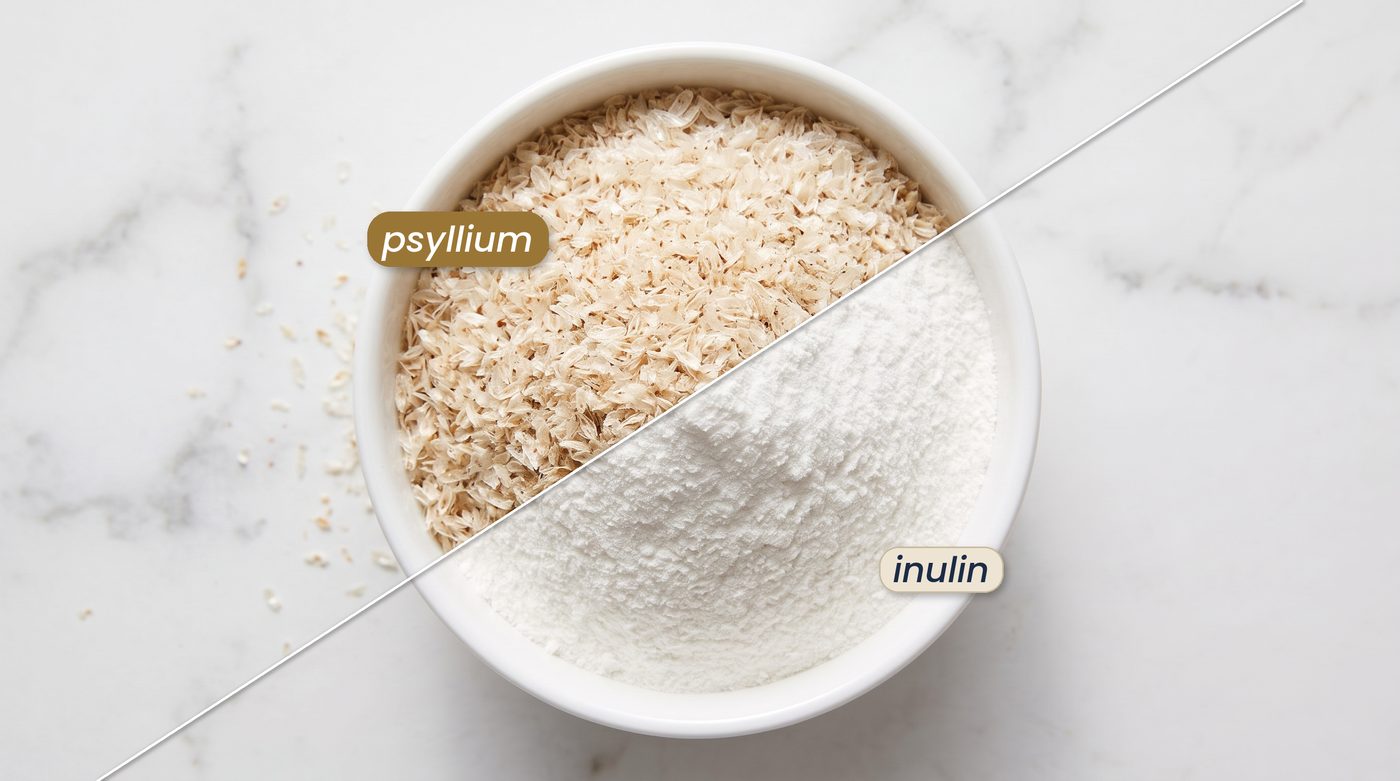
Psyllium soaks up water into a thick gel that bulks up your stool, while inulin is food for your gut bacteria. Both are called fiber, but they do two different jobs.
One forms a gel and mostly passes through you, the other gets fermented and feeds your microbiome.
What's actually different?
Psyllium
The bulker · "Metamucil"
- Forms a thick gel. Psyllium husk soaks up water and swells into a gel, so it bulks up and softens stool and slows digestion down.
- Barely fermented, so low gas. Most of the psyllium passes straight through you, which is why it rarely causes bloating.
Inulin
The prebiotic · chicory root
- Feeds your gut bacteria. Inulin is a prebiotic, so your good bacteria ferment it and multiply, especially the Bifidobacteria.
- Fully fermented, so more gas. That same fermentation makes gas, so inulin can cause bloating, especially above about 10 grams a day.
How they compare, side-by-side
| Psyllium | Inulin | |
|---|---|---|
| Amount | 2 tsp (~5 g) | 2 tsp (~7 g) |
| Comes from | Psyllium seed husk | Chicory root |
| Calories | ~10 | ~10 |
| Fiber per serving | ~4 g (14% DV) | ~6 g (21% DV) |
| Fiber type | Soluble, viscous | Soluble, non-viscous |
| Prebiotic (feeds bacteria) | Minimal | Strong |
| Fermented by gut bacteria | Very little | Rapidly and fully |
| Likely to cause gas or bloat | Low | Higher |
| Consistency when mixed in water | Thick gel | Stays liquid |
| Adds bulk to stool | Yes | No |
| Lowers LDL cholesterol | Yes | No |
Highlighted cell is the more supportive option for that row. Values are typical per 2 teaspoons and vary by brand and product. DV is percent of the FDA Daily Value for an adult (fiber 28 g).
What jumps out
🧻
They do different gut jobs
Psyllium bulks and softens stool, so it can help with both constipation and loose stools. Inulin feeds your bacteria, so it supports your microbiome but does not add much bulk.
❤️
Psyllium is the cholesterol one
Psyllium's gel traps bile and lowers LDL cholesterol. The FDA even lets psyllium products claim that 7 grams a day of its soluble fiber may lower heart disease risk. Inulin does not do this.
💨
Inulin is the gassy one
Because gut bacteria ferment inulin so fast, it is the one more likely to cause gas and bloating, especially above about 10 grams a day. Psyllium is usually gentler on the stomach.
🏷️
Inulin hides in packaged foods
You will see inulin listed as "chicory root fiber," "chicory root extract," or "inulin" added to bars, yogurts, and "high fiber" snacks. That added fiber is why some of those foods leave you bloated.
How to actually take them
- 💧Psyllium needs a full glass of water. Stir it in, drink it right away before it gels, and follow with more water so it does not clump or feel stuck.
- 🐢Start low and go slow with inulin. Begin with a teaspoon and build up over a couple of weeks so your gut adjusts and you dodge the worst of the gas.
- 🥣Inulin dissolves clear and tastes slightly sweet, so it stirs into coffee, yogurt, or oatmeal without changing the texture. Psyllium will thicken whatever you add it to.
- 🍎Supplements are a backup, not a replacement. Real food fiber from beans, oats, fruit, and vegetables brings both types plus the vitamins and minerals a scoop of powder cannot.
The bottom line
Psyllium and inulin are both fiber, but they are different tools for different jobs. One bulks up and passes through, the other gets fermented and feeds your gut.
- Reach for psyllium when you want help with regularity in either direction, steadier blood sugar, or lower cholesterol, and you want to keep gas low.
- Reach for inulin when your goal is feeding a healthy gut microbiome, and you can build the dose up slowly to stay comfortable.
There is no better fiber here, just the one that fits what your body needs. And if gas or bloating shows up, that is information, not failure, so we can adjust the type or the amount.
In FoodFlip terms
A fiber supplement is not a Portion. Psyllium and inulin add almost no usable calories, so they do not count toward your Carb Portions, they are a free add-on.
Want a plan built for you?
Custom FoodFlip Portions, simple recipes, and a community that cheers you on.