← All posts
Purple cabbage vs green cabbage... what's the difference??
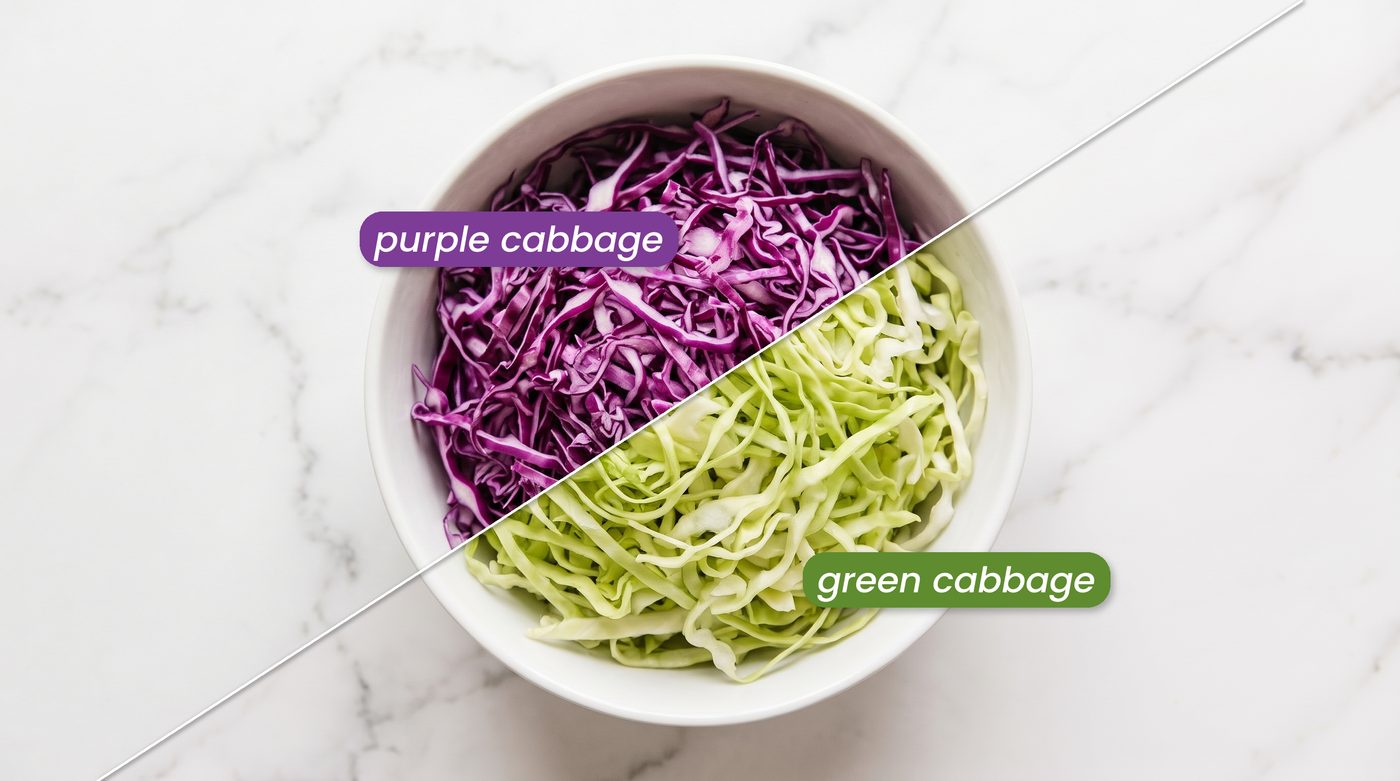
Purple cabbage has purple pigment that green cabbage does not, an antioxidant called anthocyanins.
Both are one FoodFlip Veggie Portion.
What's actually different?
Purple cabbage
- Purple color from anthocyanins (an antioxidant; 1 cup purple cabbage has ~185 mg anthocyanins)
- A little more vitamin C and potassium
- Texture and taste: firmer and more peppery raw
Green cabbage
- No purple color and no anthocyanins
- More vitamin K and folate
- Softer, milder leaves; the classic for slaw, soup, and stir-fry, and usually cheaper
Nutrition differences, side-by-side
Per 1 Veggie Portion (~1 cup shredded, about 89g), raw.
| Purple | Green | |
|---|---|---|
| Amount | ~89g | ~89g |
| Calories | ~30 | ~28 |
| Protein | 1.1g | 0.9g |
| Total carbohydrate | 6.0g | 5.7g |
| of which fiber | 1.9g (7% DV) | 2.2g (8% DV) |
| Fat | 0.2g | 0.2g |
| Vitamin C | 48mg (53% DV) | 36mg (40% DV) |
| Vitamin K | 29mcg (24% DV) | 53mcg (44% DV) |
| Vitamin A | 50mcg (6% DV) | 4mcg (0% DV) |
| Folate | 16mcg (4% DV) | 38mcg (10% DV) |
| Potassium | 239mg (5% DV) | 184mg (4% DV) |
Highlighted cell is the higher of the two, where more is meaningful. DV is percent of the FDA Daily Value for an adult. Values rounded, raw cabbage, USDA data.
What jumps out
🫐
Anthocyanins - purple cabbage only
Purple cabbage gets its color from anthocyanins, the same antioxidant pigment in blueberries and blackberries. Green cabbage has none.
🍊
Vitamin C - purple has more
Per cup, purple cabbage has about 48mg of vitamin C, over half a day's worth, versus green cabbage's 36mg. Both are a genuinely good source, purple just edges ahead.
🥬
Vitamin K - green has more
Green cabbage has about 53mcg of vitamin K per cup versus purple's 29mcg. Vitamin K helps your blood clot and supports your bones. (If you take a blood thinner, keep your cabbage intake steady, not zero.)
😋
Texture and taste
Green cabbage has softer, milder leaves, which is why it's the usual pick for slaw, soup, and stir-fry. Purple cabbage is firmer and more peppery raw, and it keeps its crunch and bright color in salads.
Easy ways to use them
- 🥗Shred either one raw for slaw or to top a bowl. Purple keeps its bright color and crunch, green stays mild and tender.
- 🍳Sauté or stir-fry either with a little oil and garlic for a fast, warm side.
- 🌮Pile either on tacos, sandwiches, or grain bowls for crunch. Purple adds a pop of color that makes the plate look finished.
- 🍋Fun kitchen science: purple cabbage's anthocyanins react to acid. A squeeze of lemon or vinegar keeps it bright pink, and it's a classic kids' experiment (add baking soda and it turns blue-green).
The bottom line
Purple and green cabbage are the same vegetable, nearly the same calories and carbs, and both count as one FoodFlip Veggie Portion. The choice comes down to color, a few vitamins, and texture.
- Choose Purple cabbage when you want anthocyanin antioxidants, a little more vitamin C and potassium, bright color, and a firmer crunch that holds up raw.
- Choose Green cabbage when you want more vitamin K and folate, softer and milder leaves for slaw, soup, and stir-fry, or usually a lower price.
Both are a whole, crunchy, low-calorie veggie you can enjoy freely, so there's no wrong pick here. Even better, use both. The two colors on one plate look beautiful and cover a wider range of nutrients.
In FoodFlip terms
A cup of shredded cabbage, purple or green, is 1.0 Veggie Portion 1.0 V (about 25 to 30 calories).
Want a plan built for you?
Custom FoodFlip Portions, simple recipes, and a community that cheers you on.